
The "Wisdom and Eloquence" conference offered last week by Father Petersen was wonderful. It is a cross between a Higher Things conference and a weekend Bible retreat. For three days we worshiped, studied and played. It was wonderful to see so many children as I am certain they out numbered the adults 4-1. Worship three times each day with the Sacrament every day was very refreshing and healing. The plenary with Father Bender was not only enlightening but it enhanced ones own ability to teach the Catechism. The sectionals provided a wide variety of topics that brought forth lively discussion and learning. The evening "fun" brought home simple yet fun ways to enjoy the family and family time.
All the way around it was done well and I highly recommended it for those who can get to Ft. Wayne for three days in August as I hope and presume it will be again next year. Check out Father Petersen's blog at http://redeemer-fortwayne.org/blog.php and you can see what went on.
Thanks again Dave, it was a pleasure and a privilege.
Showing posts with label Christian Education. Show all posts
Showing posts with label Christian Education. Show all posts
10 August 2010

13 May 2009
Music Graced by God
Last night we had our Spring Recital at Christ Lutheran Academy. Each fall (winter) and spring we typically have a recital to showcase the wonderful musical talent that our student body possesses. In a school of 29 students in grades 1-8, we have 24 piano students, plus viola, guitar, and I don't even know what else! This is in addition to our choral program, which involves all our our students in many different ways.
This strong music program has played itself out academically at our schools at many levels. Music teaches discipline, learning to practice, intervals, it helps with mathematics, language, and learning how to focus on a task. Our music program not only involves piano and voice, but musicals (grades K-3 recently performed the Selfish Giant, see pic below), and even some dance!
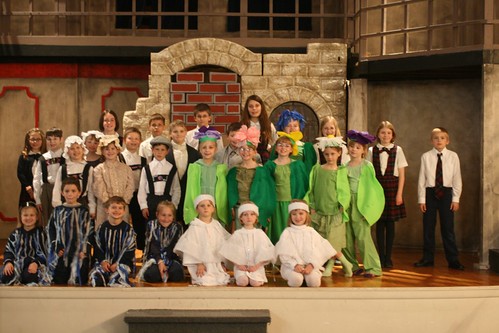
In addition all of this, the spiritual benefits are myriad. How much singing is done in church, and how does God use music and song to carry the Gospel? It is hard to underestimate the spiritual benefits that a solid music program can have upon the individual and a congregation.
As a congregation my parish is known as a singing church. If you'll allow me to brag just a little, I can throw nearly anything at them in terms of hymns or liturgy, and they will get it within a couple tries, and will probably learn to love it within half a dozen. There are a lot of reasons for that, but one of the big ones is that we have so many children at our church that attend our Academy and who learn music and hymnody every day. Every Sunday I can hear them singing, with these beautiful clear voices, teaching us adults what it means to sing to the Lord a new song (Ps. 98:1).
So who is the inspiration behind our fine music program? Really there are two people, although many others could be mentioned:

Monica Scholz (on the left) is our piano teacher. She comes in to CLA I think two days a week to teach nearly all of our students. Because of the flexibility of a multi-grade classroom, the students are able to take their piano lessons during the day, and make up their school work at another time. One less trip for the parents! (That can't be bad.) Monica is also the music director and one of the organists at Messiah Lutheran Church, my congregation.
Kathryn Peperkorn (on the right) is our choir director. She comes to CLA for choir at least twice a week, but it often ends up being more than that. The choir sings at our two congregations (Messiah and Lamb of God) roughly once a month, so that CLA will sing at each parish about three or four times during the academic year. The CLA choir will also sing for special services such as Epiphany and Ascension. Kathryn, a voice teacher and professional singer, is also the artistic director for SEWPA, SouthEast Wisconsin Performing Arts.
While these two people serve as the anchor for our music program, there are other people and places that contribute as well. Elyse Ahlgrimm is our kindergarten teacher, but she is also the organist and choir director at Grace Lutheran Church in Racine. We are also blessed with the wonderful acoustics at Lamb of God Lutheran Church, where Christ Lutheran Academy resides.
This week we are learning LSB 942, Kyrie, God Father in Heav'n Above. The children know it already, their parents will learn it, and our congregations will learn it as well, thanks to all these wonderful people and places who make music such a big part of our lives.
Happy Cantate Week! Sing to the Lord a New Song!
-Pastor Todd Peperkorn
Originally posted at Christ Lutheran Academy
This strong music program has played itself out academically at our schools at many levels. Music teaches discipline, learning to practice, intervals, it helps with mathematics, language, and learning how to focus on a task. Our music program not only involves piano and voice, but musicals (grades K-3 recently performed the Selfish Giant, see pic below), and even some dance!
In addition all of this, the spiritual benefits are myriad. How much singing is done in church, and how does God use music and song to carry the Gospel? It is hard to underestimate the spiritual benefits that a solid music program can have upon the individual and a congregation.
As a congregation my parish is known as a singing church. If you'll allow me to brag just a little, I can throw nearly anything at them in terms of hymns or liturgy, and they will get it within a couple tries, and will probably learn to love it within half a dozen. There are a lot of reasons for that, but one of the big ones is that we have so many children at our church that attend our Academy and who learn music and hymnody every day. Every Sunday I can hear them singing, with these beautiful clear voices, teaching us adults what it means to sing to the Lord a new song (Ps. 98:1).
So who is the inspiration behind our fine music program? Really there are two people, although many others could be mentioned:
Monica Scholz (on the left) is our piano teacher. She comes in to CLA I think two days a week to teach nearly all of our students. Because of the flexibility of a multi-grade classroom, the students are able to take their piano lessons during the day, and make up their school work at another time. One less trip for the parents! (That can't be bad.) Monica is also the music director and one of the organists at Messiah Lutheran Church, my congregation.
Kathryn Peperkorn (on the right) is our choir director. She comes to CLA for choir at least twice a week, but it often ends up being more than that. The choir sings at our two congregations (Messiah and Lamb of God) roughly once a month, so that CLA will sing at each parish about three or four times during the academic year. The CLA choir will also sing for special services such as Epiphany and Ascension. Kathryn, a voice teacher and professional singer, is also the artistic director for SEWPA, SouthEast Wisconsin Performing Arts.
While these two people serve as the anchor for our music program, there are other people and places that contribute as well. Elyse Ahlgrimm is our kindergarten teacher, but she is also the organist and choir director at Grace Lutheran Church in Racine. We are also blessed with the wonderful acoustics at Lamb of God Lutheran Church, where Christ Lutheran Academy resides.
This week we are learning LSB 942, Kyrie, God Father in Heav'n Above. The children know it already, their parents will learn it, and our congregations will learn it as well, thanks to all these wonderful people and places who make music such a big part of our lives.
Happy Cantate Week! Sing to the Lord a New Song!
-Pastor Todd Peperkorn
Originally posted at Christ Lutheran Academy
22 April 2009
To Clarify My Points on Catechesis and the Holy Communion
Setting aside the particular case that I previously mentioned, and taking up the question put to me concerning Dr. Luther's Catechisms, here is a more general summary of my understanding of catechesis in relation to the Holy Communion:
In the past, as a prerequisite for First Communion, I required that catechumens memorize (and recite from memory) the Ten Commandments, the Apostles' Creed, the Our Father, all but the longest of Luther's questions and answers on Holy Baptism, as well as the first two questions and answers concerning the Office of the Keys and the Sacrament of the Altar.
In more recent years, I have not required that a catechumen have all of this material memorized prior to First Communion. Rather, I have taken into account the context of ongoing catechesis that a young catechumen is receiving, both in the home and within the life of the church. I have tried to distinguish between the purpose and blessing of memorizing the Word, and the Word of God itself, which alone brings about and sustains repentance and faith. That is to say, it is not memorizing per se that catechizes the child and prepares him or her for the Holy Communion; it is the Word of God, alive with Christ and His Spirit, which does that divine work of catechization. Memorization serves and supports that Word of God; but so does a familial context of daily prayer and faithful church attendance.
Some children can memorize the Word very easily, without necessarily being engaged in the Word through daily prayer and catechesis. I rejoice in their knowledge and confession of the Word, to be sure, but I do not consider such a child to be better prepared than another child who may find memory work a constant struggle, but who is daily and richly immersed in that Word of God within the family and in the life of the Church.
In the Preface to the Large Catechism, Dr. Luther teaches (and, with him, we teach and confess) that fathers are required by God to catechize their families and households; in doing so, they are to expect their children and other members of the household to repeat the primary texts of the chief parts word for word, and that any servant who is unwilling to do so should be dismissed (and any child who refuses to do so sent to bed without any supper). Repeating things word for word is an effective pedagogical method of catechesis, and it certainly does lead to memorization of the text being repeated. However, it is the process of teaching through repetition that is fundamental, rather than the sooner-or-later outcome of verbatim memorization. The primary burden, in such a case, is on the catechist rather than the catechumen.
Dr. Luther indicates that one should know the texts of the first three chief parts before receiving the Holy Communion; but I do not equate "knowledge" with memorization (nor memorization per se with knowledge). Children are taught to know these texts by their parents and families praying them and confessing them and putting them into practice in the home. Again, this very process will foster and facilitate the memorization of these texts, but that will happen at different paces and intervals of progress, depending on the individual’s intellectual capacity and ability.
In Luther's Preface to the Small Catechism, he deplores the fact that people who are supposed to be Christians, who have been baptized and are receiving the Holy Sacrament of the Altar, do not even know the Lord's Prayer, the Creed, or the Ten Commandments. He faults the bishops and pastors, in particular, because they have not been catechizing the people even in these most basic, fundamental matters of God's Word. Thus, Luther urges his brother pastors to have compassion for the people, and to "inculcate this Catechism in the people, especially the young." It is clear from the context that what Luther means by "this Catechism" is the primary texts of the first three chief parts. His own explanations are described as these "tables and charts," which are offered as a means of assisting in the instruction of the Catechism itself.
Luther then outlines a plan for the process of catechesis, by which the people (including those already receiving the Holy Communion) are to be drilled in the basics and taught to understand them. It is evident from Luther's comments and examples that he envisions this to be a pattern for ongoing, lifelong catechesis, which serves both young and old, each age according to its own circumstances.
When Luther speaks of the necessity of a fixed text, it is again clear that he has the primary texts of the first three chief parts in mind: "The honored fathers understood this well, and therefore they all consistently used one form of the Lord's Prayer, the Creed, and the Ten Commandments." Of course, the same principle applies to the explanations that Dr. Luther provides in the form of charts and tables, but he is not referring to his explanations at this point.
With the young, in particular, Dr. Luther urges that their pastors "keep to a single, fixed, and permanent form and wording, and teach them first of all the Ten Commandments, the Creed, the Lord's Prayer, etc., according to the text, word for word, so that they can repeat it after you and commit it to memory." I do note the "etc." But I also note the distinction between "repeating it after you" and "committing it to memory." The repeating, as I have indicated, is a pedagogical method that aims toward memorization.
Luther goes on to say that "those who refuse to learn . . . are not to be admitted to the Sacrament." He does not say, "those who have not yet memorized," but "those who refuse to learn." There is a big difference between these things. It is one thing to be in the process of learning, repeating things word for word, and thereby beginning to commit them to memory; and quite another thing to refuse any part in this process. In any case, it is interesting that Dr. Luther mentions only here, at this first step in the process, anything about refusing to admit someone to the Sacrament. He makes that comment here, and connects it specifically to the process of learning (not to the completion of memorization). Only afterwards, in describing the next stage in the process of ongoing catechesis, does he advise, "after they have well memorized the text, then explain the meaning so that they understand what they are saying." Here is where Luther's simple explanations are brought to the fore. But nothing more is said about refusing anyone admission to the Holy Communion.
Indeed, what Luther does go on to say, in his description of ongoing catechesis, is that the people should be taught to yearn for the Sacrament of the Altar. He writes that, "if anyone does not seek or desire the Lord's Supper at the very least four times a year, it is to be feared that he despises the Sacrament and is no Christian." "For a person not to prize highly the Sacrament is tantamount to saying that he has no sin, no flesh, no devil, no world, no death, no danger, no hell." Therefore, without setting up any law about it, the pastors should "emphasize clearly the benefit, need, usefulness and blessing connected with the Sacrament, and also the harm and danger of neglecting it."
So, are the little children not in need of this Sacrament also? Do they not have flesh and blood, and live in the world, and face the assaults of the devil? Are they not Christians, who ought to be taught to seek and desire the Lord's Supper? Although their catechesis is just beginning, and may be at a very elementary stage, they should in fact be brought to such a hunger for the Body and Blood of Christ, the Medicine of Immortality.
Exactly as Dr. Luther writes in his Large Catechism, at the conclusion of his teaching of the Sacrament of the Altar: "Let this serve as an exhortation, then, not only for us who are old and advanced in years, but also for the young people who must be brought up in Christian teaching and a right understanding of it. With such training we may more easily instill the Ten Commandments, the Creed, and the Lord's Prayer [again, the first three chief parts] into the young so that they will receive them with joy and earnestness, practice them from their youth, and become accustomed to them. For it is completely useless to try to change old people. We cannot perpetuate these and other teachings unless we train the people who come after us and succeed us in our office and work, so that they in turn may bring up their children successfully. In this way God's Word and a Christian community will be preserved.
"Therefore let all heads of a household remember that it is their duty, by God's injunction and command, to teach their children or have them taught the things they ought to know. Because they have been baptized and received into the people of Christ, they should also enjoy this fellowship of the Sacrament so that they may serve us and be useful. For they must all help us to believe, to love, to pray, and to fight against the devil." (Kolb-Wengert, 475-476)
Earlier, in his Preface to the Large Catechism, Dr. Luther has similarly stated: "As for the common people, we should be satisfied if they learned the three parts that have been in Christendom from ancient days, so that all who wish to be Christian in fact as well as in name, both young and old, may be well trained in them and familiar with them." He then goes on to identify specifically what he means by this, citing the primary texts of the Ten Commandments, the Apostles' Creed, and the Our Father. "These are the most necessary parts that we must first learn to repeat word for word. The children should be taught the habit of reciting them daily, when they arise in the morning, when they go to their meals, and when they go to bed at night." (Kolb-Wengert, 383-385)
Here we have, not only a pedagogical method for memorization, but, more importantly, the discipline of daily prayer and confession. Again, it is not those who have failed to memorize, but those who "refuse to learn these things," who should not be tolerated. Praying and confessing them several times a day with the head of the household will certainly result in memorizing them. Yet, again, it is not the accomplished fact of memorizing, but the reciting of the texts that is expected of children and all other members of the household. Once more, the texts that Dr. Luther is here referring to, as in each case above, are the primary texts of the first three chief parts. That is made explicitly clear in what he says. "For in these three parts everything contained in the Scriptures is comprehended in short, plain, and simple terms" (Kolb-Wengert, 385).
"When these three parts have been understood, it is appropriate that one ought also to know what to say about our Sacraments, which Christ Himself instituted, Baptism and the Holy Body and Blood of Christ," according to St. Matthew and St. Mark. "Thus we have, in all, five parts covering the whole of Christian teaching, which we should constantly teach and require recitation word for word." This daily recitation, coupled with sermons, Psalms and hymnody, constitutes the ongoing rhythm of lifelong catechesis; not as a pre-requisite before receiving the Sacrament, but as the life of the Christian who has been baptized and is receiving the Sacrament. "The reason we take such care to preach on the catechism frequently is to impress it upon our young people, not in a lofty and learned manner but briefly and very simply, so that it may penetrate deeply into their minds and remain fixed in their memories." (Kolb-Wengert, 385, 386)
Memorization is an important and salutary aim, one that is accomplished by the tried and tested pedagogical method of repeating fixed texts, word for word, on a regular basis. Repetition is the mother of learning. That remains true and necessary, not only prior to First Communion, but all life long. For, as Dr. Luther writes in his longer (later) preface to the Large Catechism:
"I am also a doctor and a preacher, just as learned and experienced as all of them who are so high and mighty. Nevertheless, each morning, and whenever else I have time, I do as a child who is being taught the catechism and I read and recite word for word the Lord's Prayer, the Ten Commandments, the Creed, the Psalms, etc. I must still read and study the catechism daily, and yet I cannot master it as I wish, but must remain a child and pupil of the catechism — and I also do so gladly. These fussy, fastidious fellows would like quickly, with one reading, to be doctors above all doctors, to know it all and to need nothing more. Well this, too, is a sure sign that they despise both their office and the people's souls, yes, even God and His Word. They do not need to fall, for they have already fallen all too horribly. What they need, however, is to become children and begin to learn the ABCs, which they think they have long since outgrown. . . .
"And what else are these bored, presumptuous saints doing — people who will not read and study the catechism daily and have no desire to — except thinking that they are more learned than God Himself and all His holy angels, Prophets, Apostles, and all Christians? God Himself is not ashamed to teach it daily, for He knows of nothing better to teach, and He always keeps on teaching this one thing without proposing anything new or different. And all the saints know of nothing better or different to learn, although they cannot learn it to perfection." (Kolb-Wengert, 380-381, 382)
In all of the above, Dr. Luther distinguishes the primary texts of the first three chief parts as uniquely fundamental and foundational, and as the minimum that any Christian ought to know, including those "common people" who are already receiving the Sacrament of the Altar. These texts are to be read and recited daily, prayed and confessed morning, noon and night. A refusal to learn them in this fashion is tantamount to denying and despising the Christian faith altogether. Though these are the ABCs of the faith, they are not easily mastered — no, they are never perfectly mastered by anyone, of any age, in this life on earth — but they are the touchstone of ongoing, daily and lifelong catechesis for each and every Christian. They are an especially deep well, because all of Holy Scripture is summarized in these three chief parts; yet, they are also prayed and confessed by even the very young children.
In addition to these first three chief parts, the primary texts of the Sacraments should properly be learned, as well. And all of these things should be the object of preaching and teaching on a regular basis. To this end, Dr. Luther offers his Smaller and Larger Catechisms as means of assistance. The Psalms and Hymns of the Church also contribute to increased knowledge and understanding of all these things. So that Christians of every age are always growing from and into these chief parts of the Christian faith and life.
19 April 2009
Let the Little Child So Examine Herself
What is a pastor to do, when one of the baptized faithful looks him in the eye and asks to be given the Body and Blood of Christ? One who is pious and sincere, a devout believer, ongoingly catechized in the chief parts of the Christian faith, a lover of Christ Jesus, adoring of His Passion, regularly in church, not living an immoral or scandalous life, not propounding false doctrine, and not belonging to any other confession or communion than that of our own congregation and fellowship. One who happens to be three years old.
Yes, I know, let a man so examine himself, and so partake of the Sacrament. But what does this mean for us? And what does that look like, per se? Must it be and look the same in each case? Or does this self-examination belong to the propria of each particular communicant? Does it require that, without the assistance of parents and pastors, an individual must know certain texts by heart and be able to recite them, cognitively comprehend the grammar and syntax of them, and discuss them intellectually? Is self-examination an internal matter of the heart, or a matter of public confession, or both, or neither?
When St. Paul admonishes the Church to let a man so examine himself, the holy Apostle addresses, specifically, the case of those communicants who were failing to discern and distinguish the Body and Blood of Christ from ordinary food; and who, so failing in that discernment of the sacramental Body, were making distinctions between the members of the Body of Christ, in the way that ordinary food may be distinguished according to class and kind. That failure strikes me, not as a lack of rational knowledge, but as a lack of reverence before God and a corresponding lack of courtesy toward the brother and sister in Christ. It is a failure of faith and love, not of inadequate memory work.
However, I am not here contemplating the prospect of "infant communion." I'm considering the case of a three-year-old who does have a rational knowledge of Christ and His Word, and who does verbally confess the faith in which she has been baptized and in which she continues to be catechized. She may not know all the vocabulary words, but she knows her own need, and she knows her dear Savior. She knows and loves Jesus for who He is and for what He has done for her. She also knows what the Sacrament is, and that it is a good and blessed gift, and that she desires to receive it from her pastor as from Christ, her Good Shepherd, Himself.
Should she simply be confirmed and be done with that? In my opinion, no; although I am not nearly so hung up on the why, when and wherefore of the man-made rite of confirmation as I am concerned with the catechesis of the Word of God and the actual administration of the Holy Communion. Catechesis is, or ought to be, an ongoing and lifelong activity for every Christian. Discipleship is a way of life, a living and walking in the way of Christ, not a plateau that is reached at some particular point, whether early or late. The baptized continue to grow and mature in the faith and knowledge of Christ Jesus, unto life everlasting. Therefore, I resist the notion that "confirmation" should be treated as an arrival at some threshold of Christian achievement. It is a public confession of the faith, and an adult assertion of one's place vis-a-vis the church and the world. If I had my druthers, as I have mentioned elsewhere in the past, the rite of confirmation would be reserved until the verge of adulthood, whether at 18 or 21, at the point of going off to college or getting married. But, in any case, I think that has little to do with readiness or worthiness for the Holy Communion.
The self-examination with which a person is to approach the Holy Communion, I believe, does not derive from one's cognitive abilities, capacities or knowledge, but is a matter of the Word of God having it's way with the Christian: the Law of God that kills the sinner, and the Gospel that raises the dead to newness of life in Christ through the forgiveness of sins. Does that work of God and a Christian's self-examination happen on a cognitive level? Surely it does; not as arising out of cognition, but rather as the Word of God engages the whole person. The same self-examination occurs in the rite of Holy Baptism, and belongs to the repentant faith which defines the entire Christian life.
There is a need for discernment of the Body of Christ, both the Body that is given for us Christians to eat in the Sacrament, and that Body of Christ which comprises the members of His Church. These things go together. But what is the nature and expression of discernment? Is it not demonstrated in a desire for the Body of Christ and in the innocence of a little child who does not discriminate against the members of the Church? Or what is it that we would otherwise be looking for, exactly? I am far less concerned that any of my little three-year-old parishioners will despise or shun their brothers and sisters in Christ, than I sometimes am in the case of adults. And I am certainly no more inclined to question the sincerity and truth of a little child's confession of the Body and Blood of Christ, than I ever am in the case of an older child or adult who is able to recite the blessed words of the Small Catechism.
What I am pressing for is a new way of thinking about and implementing the criteria for admittance to the Holy Communion. I'm not advocating less catechesis, but ultimately more; only not as a completed pre-requisite before receiving the Sacrament, but as an ongoing context within which a person receives the Sacrament. Nor am I suggesting that self-examination and public confession be done away with, but that self-examination and public confession be assisted by those entrusted with the care and catechesis of the communicant, and that examination and confession be undertaken in ways congruent with the communicant's personal capacities.
The three-year-old who looked me in the eye and asked me to give her the Body and Blood of Christ Jesus has been baptized. She has been and continues to be catechized in the Word of God. She knows and prays the Our Father with her family and her congregation. She knows and confesses the Creed with her family and her congregation. She knows that she has needs and hungers, frailties and weaknesses; that she does things she should not, and fails to do things she should; and that her dear Father in heaven loves her, forgives her, and graciously provides for her through parents and pastors and others in her life. She knows who Jesus is, and that He is her Savior; that He died for her and rose again; and that He is the One whom the Church is all about. She knows that the Sacrament of the Altar is the Body and Blood of that same Lord Jesus Christ, whom she loves, and she desires to receive at His Word what He gives.
Though it broke my heart, I did not commune her when she asked again most recently (it was certainly not the first time). But as I have continued to reflect upon her request, and to consider her faith and her confession, I am more and more inclined to say, let the little child so examine herself, and so partake of the Sacrament. Indeed, I am constrained by another Word of the Lord that seems increasingly pertinent: Let the little children come to Me, and do not hinder them; for the Kingdom of God belongs to such as these.
23 February 2009
Proposed Pastoral Practice regarding Confirmation and First Communion
[The following is a proposal that I have been making to our board of elders regarding the practice of confirmation and first communion here at Messiah. I would welcome your comments and suggestions. -Peperkorn]
By Pastor Todd A. Peperkorn
December 18, 2008
That Messiah Lutheran Church admit children to Holy Communion when the pastor, the child, the parents and at least one elder all concur that the child is prepared to receive Christ’s Body and Blood in Holy Communion. “Preparation” shall include but not be limited to a clear confession of faith in the Gospel by means of reciting by heart the Ten Commandments, the Apostles’ Creed, and the Lord’s Prayer, by being examined and absolved by the pastor (Individual Confession and Absolution), and by verbally expressing their desire to receive Christ’s Body and Blood for the forgiveness of sins.
That Messiah Lutheran Church confirm those children in the Christian Faith who can recite by heart the Small Catechism of Dr. Martin Luther with Explanation, who have been examined and absolved, and who are able to confess the faith and answer the questions placed upon confirmands in the Rite of Confirmation found in the Lutheran Service Book.
The reason for this proposed practice is simple: It is of great benefit for all Christians to receive Christ’s Body and Blood, and that we should be about giving our children Jesus as much as possible, and as soon as possible.
The challenges for this proposed policy are several:
1) By separating confirmation and first communion, we run the risk of denigrating the importance of the rite of confirmation.
2) This practice, while gaining acceptance in the LCMS as a whole, is not universally accepted, and does require explanation.
3) Because this is based on the confession of faith of the individual and not an arbitrary age, it makes the practice appear random, when in fact this is more consistent with our understanding of worthiness of receiving the Sacrament.
Concordia : The Lutheran Confessions, Edited by Paul Timothy McCain (St. Louis, MO: Concordia Publishing House, 2005), 185.
A Proposed Practice Regarding First Communion and Confirmation of children at Messiah Lutheran Church
By Pastor Todd A. Peperkorn
December 18, 2008
Proposed pastoral practice regarding First Communion:
That Messiah Lutheran Church admit children to Holy Communion when the pastor, the child, the parents and at least one elder all concur that the child is prepared to receive Christ’s Body and Blood in Holy Communion. “Preparation” shall include but not be limited to a clear confession of faith in the Gospel by means of reciting by heart the Ten Commandments, the Apostles’ Creed, and the Lord’s Prayer, by being examined and absolved by the pastor (Individual Confession and Absolution), and by verbally expressing their desire to receive Christ’s Body and Blood for the forgiveness of sins.
Proposed pastoral practice regarding Confirmation:
That Messiah Lutheran Church confirm those children in the Christian Faith who can recite by heart the Small Catechism of Dr. Martin Luther with Explanation, who have been examined and absolved, and who are able to confess the faith and answer the questions placed upon confirmands in the Rite of Confirmation found in the Lutheran Service Book.
Rationale
The reason for this proposed practice is simple: It is of great benefit for all Christians to receive Christ’s Body and Blood, and that we should be about giving our children Jesus as much as possible, and as soon as possible.
The challenges for this proposed policy are several:
1) By separating confirmation and first communion, we run the risk of denigrating the importance of the rite of confirmation.
2) This practice, while gaining acceptance in the LCMS as a whole, is not universally accepted, and does require explanation.
3) Because this is based on the confession of faith of the individual and not an arbitrary age, it makes the practice appear random, when in fact this is more consistent with our understanding of worthiness of receiving the Sacrament.
Quotations From the Book of Concord
6 Confirmation and extreme unction are rites received from the Fathers that not even the Church requires as necessary to salvation, because they do not have God’s command. Therefore, it is useful to distinguish these rites from the former, which have God’s direct command and a clear promise of grace.
Concordia : The Lutheran Confessions, Edited by Paul Timothy McCain (St. Louis, MO: Concordia Publishing House, 2005), 185.
38 We cheerfully maintain the old traditions made in the Church for the sake of usefulness and peace. We interpret them in a more moderate way and reject the opinion that holds they justify. 39 Our enemies falsely accuse us of setting aside good ordinances and Church discipline. We can truly declare that the public form of the churches is more fitting with us than with the adversaries. 40 If anyone will consider it in the right way, we conform to the canons more closely than the adversaries. Among the adversaries, unwilling celebrants, and those hired for pay, and very frequently only for pay, celebrate the Masses. They sing psalms, not that they may learn or pray, but for the sake of the service (as though this work were a service) or, at least, for the sake of reward. Among us many use the Lord’s Supper every Lord’s Day. They do so after they have been first instructed, examined, and absolved. The children sing psalms in order that they may learn. The people also sing so that they may either learn or pray. 41 Among the adversaries there is no catechizing of the children whatever, about which even the canons give commands. Among us the pastors and ministers of the churches are encouraged publicly to instruct and hear the youth. This ceremony produces the best fruit. 42 Among the adversaries, in many regions, no sermons are delivered during the entire year, except during Lent. Yet the chief service of God is to preach the Gospel. When the adversaries do preach, they speak of human traditions, of the worship of saints and similar trifles, which the people justly hate. Therefore, they are immediately deserted in the beginning, after the reading of the Gospel text. A few better ones begin now to speak of good works; but about the righteousness of faith, faith in Christ, and the comfort of consciences, they say nothing. Indeed, this most wholesome part of the Gospel they rail at with their reproaches. 43 On the contrary, in our churches all the sermons are filled with such topics as these: repentance; the fear of God; faith in Christ, the righteousness of faith, the comfort of consciences by faith; the exercises of faith; prayer, what its nature should be, and that we should be fully confident that it is powerful, that it is heard; the cross; the authority of officials and all civil ordinances; the distinction between the kingdom of Christ, or the spiritual kingdom, and political affairs; marriage; the education and instruction of children; chastity; all the offices of love. 44 From this condition of the churches it may be determined that we earnestly keep Church discipline, godly ceremonies, and good Church customs.Concordia : The Lutheran Confessions, Edited by Paul Timothy McCain (St. Louis, MO: Concordia Publishing House, 2005), 193.
15 July 2008
Luther on Education – Source Located
There is a famous quotation of Luther that goes,
I am much afraid that schools will prove to be the great gates of hell unless they diligently labor in explaining the Holy Scriptures, engraving them in the hearts of youth. I advise no one to place his child where the scriptures do not reign paramount. Every institution in which men are not increasingly occupied with the Word of God must become corrupt.
A brief search of the Internet can find many, many times this is quoted. But I wasn’t able to find any references to the source of that quotation. In fact, I even read one place where Luther’s authorship was doubted. (Indeed, quite a few of Luther’s popular “quotes” are not authentic.)
A little effort last week with my Luther’s Works in Logos yielded the original in the American Edition, though worded a bit differently. I imagine the quote as popularly cited comes from an older translation. The words come from Luther’s 1520 work, “To the Christian Nobility of the German Nation Concerning the Reform of the Christian Estate.”
I would advise no one to send his child where the Holy Scriptures are not supreme. Every institution that does not unceasingly pursue the study of God’s word becomes corrupt. ... I greatly fear that the universities, unless they teach the Holy Scriptures diligently and impress them on the young students, are wide gates to hell.
Luther, M. (1999, c1966). Vol. 44: Luther's works, vol. 44 : The Christian in Society I (J. J. Pelikan, H. C. Oswald & H. T. Lehmann, Ed.). Luther's Works (44:207). Philadelphia: Fortress Press.
Rob Franck
Subscribe to:
Posts (Atom)


 Posts

